SBA 7(a) vs SBA 504
7(a) is the flexible, general-purpose SBA program. 504 is built for fixed assets - real estate and heavy equipment - with long, fixed terms.
See what you qualify for
months in business
monthly sales
credit score
- 7(a) is the SBA's flexible, general-purpose program; 504 is purpose-built for fixed assets like real estate and heavy equipment.
- 504 pairs a bank loan with a CDC second loan, which is why it can reach ~10% down and long fixed terms.
- You cannot use 504 for working capital - that is a 7(a) job.
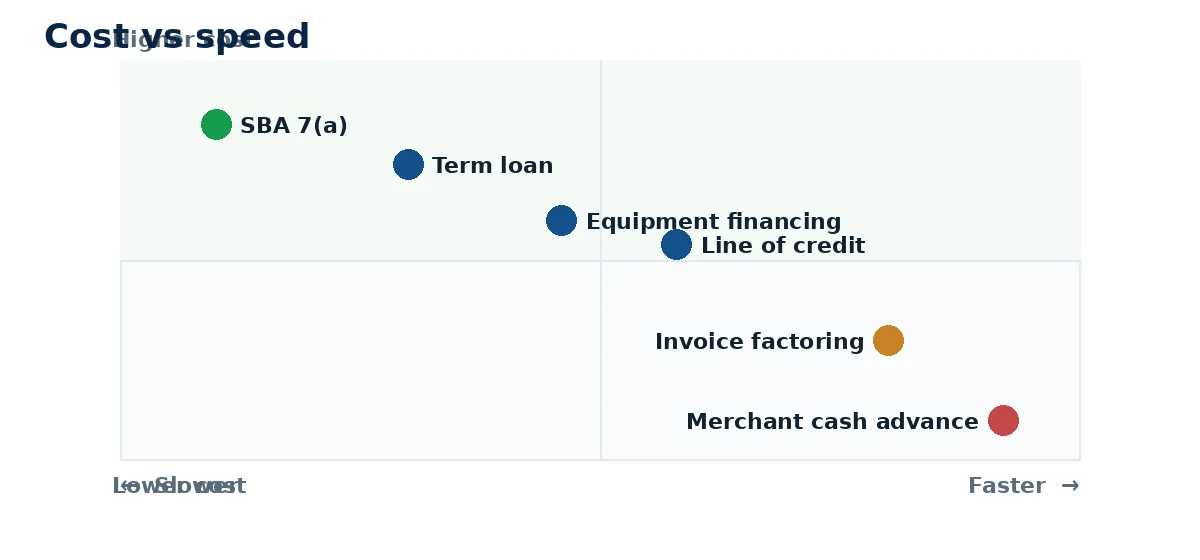
- Both are multi-week processes; 504 for real estate can take considerably longer than 7(a).
SBA 7(a) vs SBA 504 at a glance
| SBA 7(a) | SBA 504 | |
|---|---|---|
| Use of funds | Working capital, equipment, real estate, more | Fixed assets: real estate, machinery |
| Structure | Single loan, partially guaranteed | Two-part loan (bank + CDC) |
| Down payment | Often 10-20% | Often 10% |
| Terms | Up to 10 years (real estate 25) | 20-25 years, fixed |
| Best for | Flexibility across uses | Owner-occupied property, big equipment |
Choose SBA 7(a) if…
- Mixed needs: working capital, equipment, refinancing
- You want one simple loan
- Flexibility matters
Choose SBA 504 if…
- Buying owner-occupied real estate or heavy equipment
- You want the longest fixed terms
- A larger, asset-backed project
One program, two very different jobs
7(a) and 504 are both SBA-guaranteed, but they are not interchangeable. 7(a) is the generalist: working capital, equipment, furniture, refinancing, and real estate all fit, in a single loan. 504 is a specialist, built for fixed assets - owner-occupied commercial real estate and long-life heavy equipment.
That specialisation is what makes 504 attractive for the right project. Because it is designed around property, the structure is tuned for lower down payments and longer fixed terms than a 7(a) would typically deliver on the same purchase.
The practical rule: if your need is mixed or fluid, look at 7(a). If your need is a building or a big machine you will own for decades, look hard at 504.
How the 504 structure works
A 504 is really two loans working together. A conventional lender provides a first loan, typically covering about half the project. A Certified Development Company (CDC) provides a second loan, backed by an SBA-guaranteed debenture, covering a large chunk of the rest. You contribute the down payment - often around 10%.
That two-part structure is why 504 can do things a single loan cannot: a lower blended down payment and a long, fixed rate on the CDC portion. It is also why the process is heavier - two lenders, more coordination, more paperwork.
504 is not for investment property. It is designed for owner-occupied real estate, generally with meaningful owner occupancy, which is central to the program's purpose of helping businesses own where they operate.
Where 7(a) wins
7(a) wins on breadth and simplicity. One loan, one lender, and flexibility to cover working capital, equipment, and refinancing alongside real estate if needed. If your needs are not purely a fixed asset, 7(a) is the natural home.
It also wins on speed relative to a real-estate 504 - still measured in weeks, but typically less of a coordination exercise. For a business that wants SBA economics without the two-part structure, that matters.
How to decide
Start with the use of funds. If any meaningful part of it is working capital or a mixed bag of expenses, 7(a) is your program. If the whole project is a building or long-life equipment you will occupy and use for many years, compare 504 and 7(a) on the specific numbers - down payment, term, and rate - because on a large, long-hold project the 504 structure can save real money.
And plan the calendar. Whichever you choose, these are not products for a two-week deadline. Give yourself 30-45 days minimum, and longer for real estate, with complete documentation from day one.
The verdict
Use 7(a) for flexibility and general needs. Use 504 when you are buying (or building/renovating) owner-occupied real estate or long-life equipment and want the lowest long-term fixed cost.
Comparison shopping is easier with actual offers. Check what you qualify for in minutes - it won’t affect your credit.