Working Capital Loan vs Business Line of Credit
Working capital is a fixed lump sum; a line of credit is a reusable pool. One is a decision, the other is a facility.
See what you qualify for
months in business
monthly sales
credit score
- Working capital is a fixed lump sum you take once and repay on a schedule; a line of credit is a reusable pool you draw against as needed.
- You pay interest on the full amount with a working capital loan, but only on what you draw with a line.
- Use working capital for a defined, one-time gap; use a line when needs repeat and you want standby capital.
- A line can sit unused for months at no cost - working capital starts costing you the moment it funds.
Working Capital Loan vs Business Line of Credit at a glance
| Working Capital Loan | Business Line of Credit | |
|---|---|---|
| Structure | Fixed lump sum | Revolving limit |
| Interest on | Full amount | Only what you draw |
| Payments | Fixed schedule | Flexible, on balance used |
| Best for | A known, one-time gap | Recurring and variable needs |
| Draw again? | No - repay and it is done | Yes - reuse up to your limit |
Choose Working Capital Loan if…
- A specific, known amount for a specific purpose
- You want a fixed payoff
- Covering one seasonal dip or opportunity
Choose Business Line of Credit if…
- Needs that repeat month to month
- Wanting standby capital
- Managing uneven cash flow
The structural difference that drives everything
A working capital loan is a lump sum. You borrow an amount, you receive it all, and you repay it on a fixed schedule until it is done. A line of credit is a limit - a ceiling you can draw against, repay, and draw against again, for as long as the facility is open.
Nearly every other difference flows from that. Because a working capital loan commits the full principal, you pay interest on the whole thing even when it is sitting in your account. Because a line only charges you on the outstanding balance, capital you have not drawn is free.
So the first question is not which has the lower rate - it is what shape your need has. One and done, or recurring?
What each costs you in real terms
Consider a business that needs $50,000 in March for a seasonal inventory build, repays by June, then needs $50,000 again in October. With a working capital loan, it takes two loans, two applications, and pays interest on the full amount each time. With a line, it draws, repays, and draws again from one facility - paying interest only on what is outstanding.
For a genuinely one-time need, though, the working capital loan often wins on simplicity and sometimes on rate, because a defined, short payback is easier for a lender to price. The line's advantage only materialises when you use it more than once or hold capital you are not yet spending.
Watch the fees both ways - origination, draw, and maintenance fees can flip the math on a lightly used line.
Choosing by the shape of your cash flow
If you can point at a specific, dated need - a build-out, a deposit, a piece of equipment, a one-season purchase - working capital gives you a clean payoff and a payment that ends. There is a discipline to that: the obligation has a finish line.
If your needs are a pattern rather than an event - payroll that dips, invoices that arrive late, opportunities that appear unpredictably - a line fits better and is usually cheaper in total. The danger with a line is that it can feel like a permanent cushion; used that way it quietly becomes expensive debt.
A practical way to decide
Ask two questions. Will I need this money more than once in the next twelve months? And do I know, today, exactly what it is for? Two yeses with a defined purpose points to working capital; a no on either points to a line.
Many businesses do not have to choose. Holding a line for fluid needs and using a term or working capital loan for discrete projects is a healthy structure - just make sure the line stays a tool you repay and reset, not a crutch you lean on indefinitely.
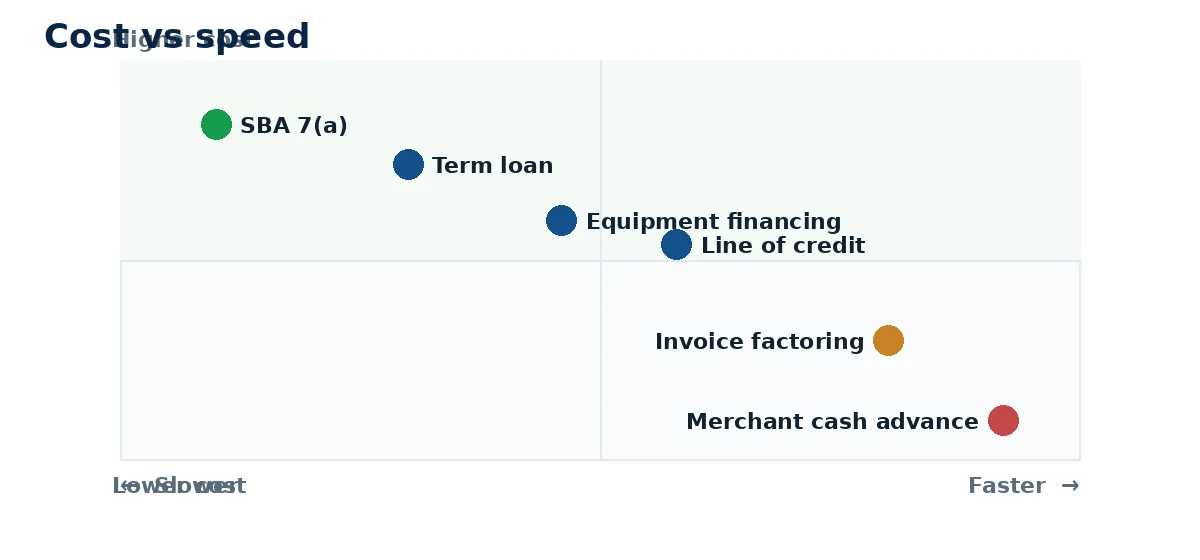
The verdict
Pick working capital for a one-time need with a clear payoff. Pick a line of credit when the need keeps coming back and you want to pay only for what you use.
Comparison shopping is easier with actual offers. Check what you qualify for in minutes - it won’t affect your credit.