Finance Financing
Financing built for finance - where compliance, staffing, and growth demand steady capital.
See what you qualify for
months in business
monthly sales
credit score
- Finance, insurance, and advisory firms need steady capital for compliance, staffing, and technology as they scale.
- A line of credit provides reusable capital for recurring costs while receivables catch up.
- Working capital funds a defined investment ahead of revenue.
- SBA loans offer lower-cost, longer-term financing for larger, planned growth.
- Most financing funds in 1-3 business days; SBA options take 30-45 days.

Why finance businesses need financing
Finance businesses run into a familiar cash-flow problem: compliance, staffing, and growth demand steady capital. The fix is not more volume - it is capital timed to that gap.
Because compliance, staffing, and growth demand steady capital, the constraint is rarely demand - it is the timing gap between money going out and money coming in. Working capital, a line of credit, or equipment financing absorbs that gap so operations keep moving while you grow.
- Compliance, staffing, and technology costs
- Growing a book of business
- Covering receivables while scaling
- Investing ahead of revenue
Financing options for finance
The mix below fits the way finance businesses actually operate. Compare as many as you like - checking won’t affect your credit.
Business Line of Credit
Revolving capital you draw from when you need it - pay only on what you use. From $10,000 to $5,000,000.
Working Capital
Fast, flexible capital to cover cash-flow gaps, seize opportunities, or invest in growth - from $10,000 to $5,000,000.
SBA Loans
SBA-backed financing with lower rates and longer terms for growth, equipment, or working capital. $10,000 to $5,000,000.
How the money fits finance cash flow
A financial-services business grows on a mix of fixed costs - compliance, licensing, technology, and qualified staff - that must be funded before the revenue they enable arrives. Regulation adds cost and timing pressure, and client or commission income often lags the work that earns it.
A line of credit handles the recurring rhythm, funding compliance and staffing needs and being repaid as income lands. Working capital covers a defined investment, and SBA financing suits larger, planned growth where the lower cost and longer term justify a slower process.
An insurance agency hiring four producers faces $60,000 in up-front salary and training costs before their books produce commissions. A line of credit funds the ramp, repaid as commission income builds over the following quarters.
For a planned acquisition or a large technology investment, SBA financing can stretch the cost over years at a lower rate - worth the 30-45 day process for a long-term commitment.
Cost, speed, and what to have ready
Lines of credit and working capital commonly fund in one to three business days; SBA loans take 30-45 days. Have business bank statements, financial statements, and business information ready. For larger deals, prepare tax returns and financials in advance to keep the process moving.
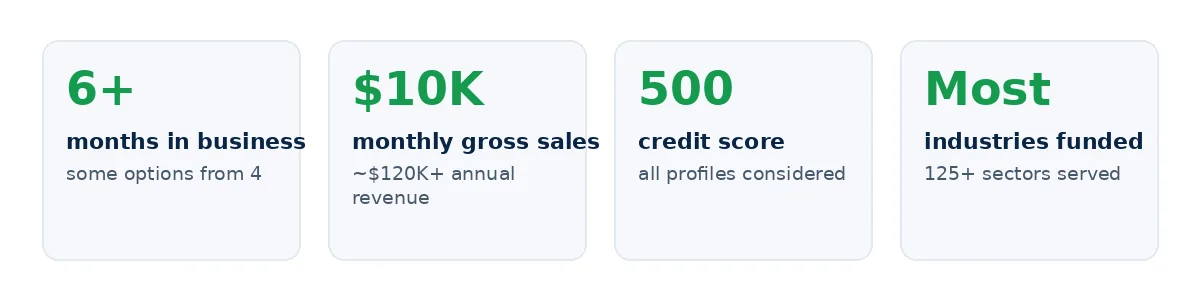
What you need to qualify
Months in business
Some options from 4 months
Monthly gross sales
~$120K+ annual revenue
Credit score
All credit profiles considered
Frequently asked questions
See what your finance business qualifies for
Free, no obligation, and it won't affect your credit.
Get Started →