Business Loan With a 500 Credit Score
By Tim Carre, Senior Vice President · Reviewed by the TopBizCapital editorial team
A 500 credit score still opens several financing doors. Compare what you can qualify for at 500, what it costs, and how to get the best terms.
- At 500, bank loans are usually out of reach - but the alternative market is built for this profile.
- Underwriting shifts to your revenue and time in business instead of your consumer score.
- Equipment financing and factoring are usually the cheapest options at 500 because an asset or invoice secures them.
- Expect smaller amounts and higher cost to start; both improve fast with a clean payment record.
- Keep statements clean and deposits steady - that does more for your offer than a small score bump.
What a 500 credit score gets you
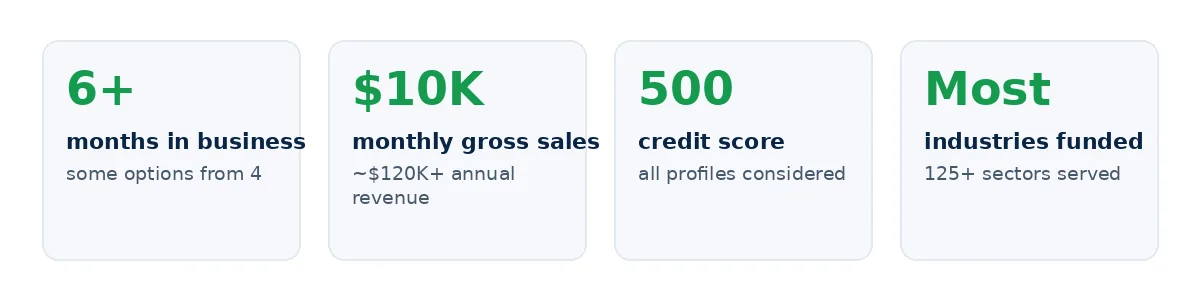
At a 500 score, conventional bank loans are usually out of reach, but the alternative market is built for exactly this profile. Expect revenue-based advances, merchant cash advances, equipment financing, and invoice factoring to be in range if your business shows steady sales and at least six months of operation.
The key mental shift is that underwriting leans on your cash flow rather than your personal score. A lender looking at your bank statements is asking 'does money come in reliably?' - a question your score cannot answer but your statements can.
Many owners at 500 are surprised by how quickly a fully-funded offer appears once they stop applying to banks and start applying to lenders who actually serve their profile.
Why 500 is not the wall it feels like
Finance marketing trains people to believe 700 is the floor for anything real. In practice, the business lending market is two-tiered: banks and SBA lenders on one side, where credit matters heavily, and the revenue-based market on the other, where it matters far less.
That second tier is enormous, fast, and competitive - which is good for you, because competing lenders mean better offers. The catch is that the second tier prices for risk, so your job is to use it well and move up the ladder, not to live there forever.
The options, ranked by typical cost
Equipment financing and invoice factoring tend to be the most affordable because an asset or a customer invoice backs the advance, which reassures the lender and lowers your cost.
Revenue-based working capital sits in the middle: sized on your revenue, repaid predictably, cheaper than an MCA but not as cheap as asset-backed options.
Merchant cash advances are the fastest and the most expensive - the tool for genuine urgency, not routine cash flow.
A personal guarantee or a co-signer can also unlock smaller amounts and better pricing, especially for newer businesses.
How much you can realistically borrow
At 500, offers are usually sized to your revenue, not your credit - commonly $10,000 to a few hundred thousand dollars, scaled to average monthly deposits and time in business. A business depositing $25,000 a month will see materially larger offers than one depositing $8,000, at the same score.
Starting smaller than you want is normal. A first facility of $20,000 that you repay flawlessly builds the record that justifies a $60,000 line six months later.
What it costs - and how to compare fairly
Alternative lenders quote factor rates, origination fees, and term lengths - not clean APRs, because none of these are true annualized loans. A 1.35 factor on $40,000 means you repay $54,000; the effective annualized cost depends on how fast you repay, and it is high.
The honest comparison is dollars: how much total do you pay for how much capital, over how long? Line the offers up that way, ignore the marketing framing, and the cheapest option usually becomes obvious.
Documents to have ready
Three to six months of business bank statements, a photo ID, and basic business details cover most applications. Some lenders add a voided check or a quick verification call. The lighter the documentation, the faster and cleaner the decision - and the more likely you are to get funded the same day.
How to raise your score while you borrow
On-time payments on the new facility, lower utilization on personal cards, and a few months of clean reporting can move a 500 into the 600s - which unlocks better pricing on your next round. Many funders report positive payment history, so performing on this facility is literally building your next offer.
Set the payment on autopay if you can. The most common self-inflicted wound at this stage is a single missed or late payment that resets your progress.
Avoiding the traps common at 500
Two traps do real damage. The first is stacking - taking a second advance to cover the first, which snowballs cost and shrinks your margin. The second is ignoring total cost because the monthly feels manageable; a payment you can 'handle' can still be financing that eats your profit.
A third, quieter trap is never graduating. If you stay on the most expensive capital indefinitely, you are subsidizing the lender's risk forever. Plan the upgrade from day one.
A realistic plan to graduate
Use the cheapest option you can qualify for now to solve the immediate need. Perform on it perfectly. In three to six months, present that payment history alongside cleaner statements and ask about a line of credit or term loan.
Repeat once more and you are borrowing at conventional prices with a repaired score - and the 500 that felt like a wall becomes a chapter you have closed.