How to Get a Business Loan With Bad Credit
By Tim Carre, Senior Vice President · Reviewed by the TopBizCapital editorial team
Yes, you can get a business loan with bad credit. See which financing options look past your score, what lenders weigh instead, and how to qualify.
- A low personal credit score narrows your options - it does not close them. Revenue-based lending is built for exactly this profile.
- Most alternative lenders underwrite your business bank statements and time in business, not just your FICO score.
- Equipment financing, invoice factoring, and revenue advances are the most accessible routes at a low score.
- Checking your options with most alternative lenders uses a soft inquiry and does not affect your credit.
- Borrowing is a ladder: use a fast option now, perform on it, and graduate to cheaper capital as your profile improves.
The short answer: yes - but the option changes
A low personal credit score narrows your choices, it does not close them. Plenty of business financing is underwritten on your revenue, time in business, and daily sales rather than your FICO score alone. That is the single most important thing to understand about financing with bad credit: the product changes, not the possibility.
Where a bank might decline you at 560, an alternative lender may approve on the strength of $15,000 a month in deposits and a year of steady operation. The trade-off is cost - options that look past credit usually price for that risk - but they exist, and for many businesses they are the difference between stalling and moving.
The productive mindset is not 'how do I hide my score' but 'what else can I show that proves I can repay'. Answer that, and there is usually a lender whose box you tick.
Why your credit score matters less than you think
A business loan is repaid from business cash flow, not from a consumer credit score. Lenders who understand this - the alternative and revenue-based lenders - build their underwriting around exactly that reality. They want to see money coming in, consistently, and a business old enough to have a track record.
This is why two businesses with identical 540 scores can get very different offers: the one with eighteen months of stable five-figure deposits looks like a fundamentally safer bet than the one with three months of erratic activity, regardless of score.
A low score is a signal, not a verdict. When it is the only signal a lender looks at, it hurts. When it sits alongside strong revenue evidence, it becomes one input among several - and often not the deciding one.
What lenders actually look at
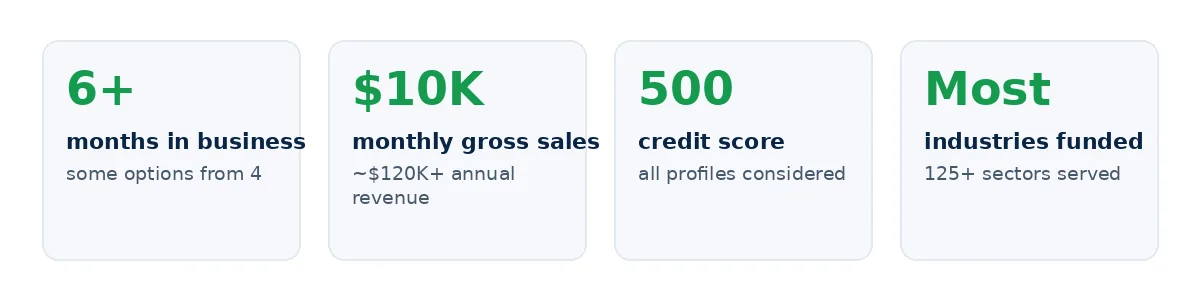
Instead of a single score, most alternative funders weigh a handful of signals: how long you have been in business, monthly gross revenue, how consistent your deposits are, and whether there are recent defaults or an open bankruptcy on file. Some also look at your business credit profile, which is separate from your personal score and can be stronger than you expect if you have paid suppliers, landlords, and utilities on time.
The practical upshot is that the improvements you can make fastest are not your credit score at all - they are the cleanliness and consistency of your business bank statements. Fewer overdrafts, fewer odd transfers, more steady deposits, and a separate business account do more for your approval odds in a month than a modest score bump does.
Depth of history matters too. Six months is often the minimum, twelve is comfortable, and two years opens up the widest range of options and the best pricing.
The options that look past a low score, ranked
Merchant cash advance (MCA): the loosest credit requirements and the fastest funding, repaid as a percentage of future sales. Best reserved for genuine urgency because the cost is the highest of anything on this list.
Revenue-based working capital: a fixed advance sized on your revenue rather than your score, with more predictable repayment than an MCA. A solid middle option when speed and stability both matter.
Invoice factoring: underwritten on your customers' credit, not yours, which makes it unusually accessible for B2B businesses with creditworthy clients - staffing, trucking, wholesale, distribution, and professional services. It scales with your sales, so growth funds itself.
Equipment financing: the asset serves as collateral, which offsets a weak score and can bring a stronger offer than you would otherwise see. If you are buying a truck, machine, oven, or vehicle, this is often the cheapest route available at a low score.
Purchase order financing: a confirmed, creditworthy order can fund the goods to fill it, again leaning on your customer's credit rather than your own.
SBA loans and conventional bank loans: usually out of reach at a genuinely low score, but worth revisiting once you have a longer track record and repaired history.
How much a bad score actually costs you
Cost is where a low score shows up most. Lenders that look past credit price for it - through higher factor rates, shorter terms, or larger fees. Do not compare a 1.4 factor rate on an advance to a 12% APR term loan as if they were the same thing; annualize everything before you decide.
The honest framing is that bad-credit financing is a premium you pay for access. The goal is not to stay there - it is to use it, perform flawlessly on it, and let that performance lower your cost on the next round. Businesses that treat their first alternative facility as a stepping stone often find their second is materially cheaper.
Documents to have ready
Three to six months of business bank statements do most of the work. Some lenders also ask for a photo ID, a voided check, and basic business details - legal name, address, industry, and time in business. The lighter and more consistent the documentation, the faster and better the decision.
Have them ready before you apply. Applying half-prepared, then scrambling for PDFs, is the most common reason a same-day decision stretches into a week.
How to improve your odds before you apply
Separate your business and personal finances if you have not already - commingling is a red flag. Keep deposits steady and avoid a cluster of overdrafts in the months before you apply. Pay down a revolving card if you are close to a scoring threshold; even a modest jump can unlock better pricing.
And do not fire off five applications in a week - each hard pull can ding your score, and it signals desperation. Check your options through one soft-inquiry pre-qualification first, then apply to the best match.
What to expect after you apply
Most alternative lenders give a same-day decision and fund within one to three business days. You should see clear terms up front - amount, total cost, repayment method, and timing - before you commit to anything. If the terms are murky, that is your signal to pause.
Once funded, pay on time, every time, and resist the urge to immediately take a second advance to cover the first. Stacking is how a manageable facility becomes an unmanageable spiral.
A realistic 90-day plan to better pricing
Month one: get funded through the most affordable option you qualify for, and get your statements clean and consistent.
Month two: perform perfectly on the facility, keep deposits steady, and open or use trade accounts that report to business credit bureaus.
Month three: ask about a line of credit or term loan with the same lender or another - your payment history with the first facility is now a track record you can point to.
Repeat that cycle and the score that blocked you in month one becomes a footnote by the end of the year.