No-Doc Business Loans
By Tim Carre, Senior Vice President · Reviewed by the TopBizCapital editorial team
No-doc business loans trade documentation for speed, using bank statements instead of tax returns. Here is how they work, what they cost, and who qualifies.
- No-doc does not mean no information - it means no tax returns or financial statements; revenue is verified from bank statements.
- Statement-based underwriting is why these loans decide fast and lean less on your credit score.
- Amounts commonly run $10,000 to $500,000+, scaled to average monthly deposits.
- They cost more than a fully documented bank loan - the premium buys speed and lighter paperwork.
- Have 3-6 months of business bank statements ready; that single document does most of the work.
What 'no-doc' really means
The name is misleading in a useful way. A no-doc business loan does not skip verification - it skips a particular kind of documentation: tax returns and formal financial statements. Instead, the lender verifies your revenue directly from your business bank statements, usually three to six months of them.
That is why the same product is also called a stated-income or bank-statement loan. Nothing is taken on faith; the statements prove what the business actually deposits, month by month. In many ways it is a more current picture of your finances than a tax return filed months ago.
What you are really trading away is the ability to use paper losses (depreciation, deductions) to shape your stated income. Statement-based lenders look at cash in, not net income on a return.
Why bank statements replaced tax returns
Traditional underwriting relied on tax returns because they were the only verifiable record of a business's finances. But returns are annual, historical, and shaped by accounting decisions - they can show a modest net income while the business is depositing six figures a month.
Bank statements answer a more immediate question: is money reliably coming in? For a lender deciding whether a business can service a short-term obligation, that is often the more relevant question. It is also faster to obtain and verify.
The result is a product that decides in hours or a day rather than weeks, and that judges a business on its cash flow rather than the shape of its tax strategy.
Who no-doc financing serves best
Three profiles benefit most. First, businesses that need capital quickly and cannot wait weeks for a documented loan. Second, businesses with informal bookkeeping but strong deposits - plenty of healthy small businesses do not keep pristine financials. Third, businesses whose tax returns understate their true cash flow because of legitimate deductions, depreciation, or pass-through structure.
If you recognise yourself in any of those, a statement-based lender can see strength that a tax-return-only lender would miss entirely.
Amounts, speed, and cost
Amounts typically start around $10,000 and can reach $500,000 or more, sized primarily to your average monthly deposits and time in business. A business depositing $40,000 a month will see materially larger offers than one depositing $12,000.
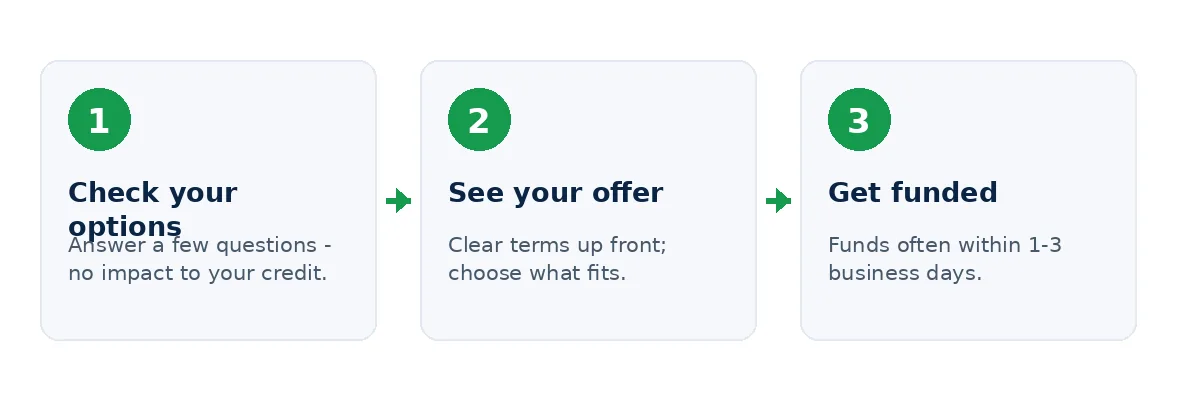
Speed is the headline: decisions are often same-day, with funding in one to three business days. Cost is the trade - no-doc capital is more expensive than a fully documented bank loan, because the lender is taking on more uncertainty with less paperwork and, often, a lighter credit requirement.
The right way to judge the premium is against what the speed is worth to you. If waiting three weeks would cost you a contract or a supplier discount worth more than the premium, the math favours no-doc. If you can afford to wait and your financials are strong, a documented loan will be cheaper.
What you need to prepare
The document set is short: your last three to six months of business bank statements, a photo ID, and basic business information - legal name, address, industry, and time in business. Some lenders add a voided check or a brief verification call.
The most common reason a fast application becomes a slow one is incomplete statements. Download the full, unredacted months in advance, and apply early in the day so underwriting has a full business day to work with.
The marketing trap to watch for
'No doc' is a marketing phrase, and some lenders use it loosely for products that are actually expensive merchant cash advances or advances with punishing terms. Two habits protect you: read the total repayment amount, not the monthly payment, and insist on seeing the full cost in writing before you commit.
If a lender cannot clearly state the amount advanced, the total repaid, the repayment method, and the timing, treat that as a warning. Speed and simplicity are good reasons to choose no-doc financing - vagueness is not.
When documented financing is the better choice
If you can wait and your financials are strong, SBA loans, conventional term loans, and lines of credit are materially cheaper. The documented route rewards businesses with clean books and a solid credit profile, and the savings over the life of a loan can be substantial.
So the honest rule is: choose no-doc when speed or your documentation reality demands it, not because it feels easier. The premium you pay for skipping paperwork is real money.
Building toward cheaper capital
Every no-doc facility you perform on is a track record. Pay on time, keep deposits steady, and avoid new overdrafts, and within six to twelve months you can usually move to a revenue-based facility, then a line of credit, at lower cost.
Think of no-doc capital as the entry rung, not the destination. Used that way, its premium is a temporary cost of access rather than a permanent tax on your growth.