Inventory Financing vs Business Line of Credit
Inventory financing uses your stock as collateral to buy more stock. A line of credit gives you unsecured flexibility. Choose by whether inventory is the bottleneck.
See what you qualify for
months in business
monthly sales
credit score
- Inventory financing uses the stock itself as collateral to fund more stock; a line of credit is unsecured, general-purpose capital.
- Inventory financing scales with what is on your shelves; a line scales with your approved credit limit.
- Choose inventory financing when stock is the bottleneck; choose a line when needs extend beyond inventory.
- Many businesses use a line for operating expenses and inventory financing for buying stock.
Inventory Financing vs Business Line of Credit at a glance
| Inventory Financing | Business Line of Credit | |
|---|---|---|
| Collateral | Your inventory | General credit |
| Purpose | Buying more inventory | Any business purpose |
| Scales with | Stock on hand | Your credit limit |
| Best for | Retail, e-commerce, distributors | Broad, recurring needs |
| Reuse | Revolving against stock | Revolving, reusable |
Choose Inventory Financing if…
- Stocking up for a season
- Retail, e-commerce, wholesale
- Inventory is your growth constraint
Choose Business Line of Credit if…
- Needs beyond inventory
- You want unencumbered flexibility
- Payroll, marketing, and more
Two ways to fund the same purchase
Both products can put inventory on your shelves, but they get there very differently. Inventory financing is secured by the stock itself - the goods act as collateral, and the facility revolves against the value of what you hold. A line of credit is unsecured and general: you draw on it for anything, and nothing specific backs it.
That difference decides when each fits. If inventory is your binding constraint - the thing standing between you and more sales - aligning capital directly with your stock is efficient and can be easier to obtain than a comparable unsecured line.
If your needs range beyond stock, a line of credit's flexibility becomes the stronger argument.
Why inventory financing suits retailers and distributors
Retailers, e-commerce sellers, wholesalers, and distributors all share the same growth mechanic: you cannot sell what you do not have. Stocking up for a season or a large order ties up cash in goods that only turn into money weeks later.
Inventory financing solves that by lending against the inventory rather than asking you to fund it from savings. It scales with your stock levels, so as you grow and hold more goods, the facility can grow with you - which matters for businesses whose busy season demands a big purchase months in advance.
Eligible inventory is generally sellable goods with predictable demand and clear valuation - not obsolete or highly specialised stock that a lender cannot reliably price.
Where a line of credit wins
A line of credit is not tied to a single asset class, which is its strength. It covers payroll, marketing, rent, a hiring push, a software investment, or a cash-flow dip - anything the business needs. It is also unencumbered, so your inventory is not committed to a lender.
For businesses whose constraint is not specifically stock, that breadth is worth more than the inventory-specific structure. If you qualify well, a line can also be cheaper per dollar than an asset-specific facility.
The trade-off is that a line is sized to your credit profile, not your stock. If your ambition is to triple your inventory ahead of a season, a line capped by your limit may simply not scale the way inventory financing can.
Combining them
These two are natural companions. A line of credit handles the operating swings the business lives with every month; inventory financing funds the deliberate stocking-up that a line alone may not support. Many growing retailers and distributors run both.
The test for which you need first is simple: is my growth gated by how much stock I can afford to buy? If yes, inventory financing addresses the constraint directly. If no, start with a line of credit and add inventory financing when a season or a big order demands it.
The verdict
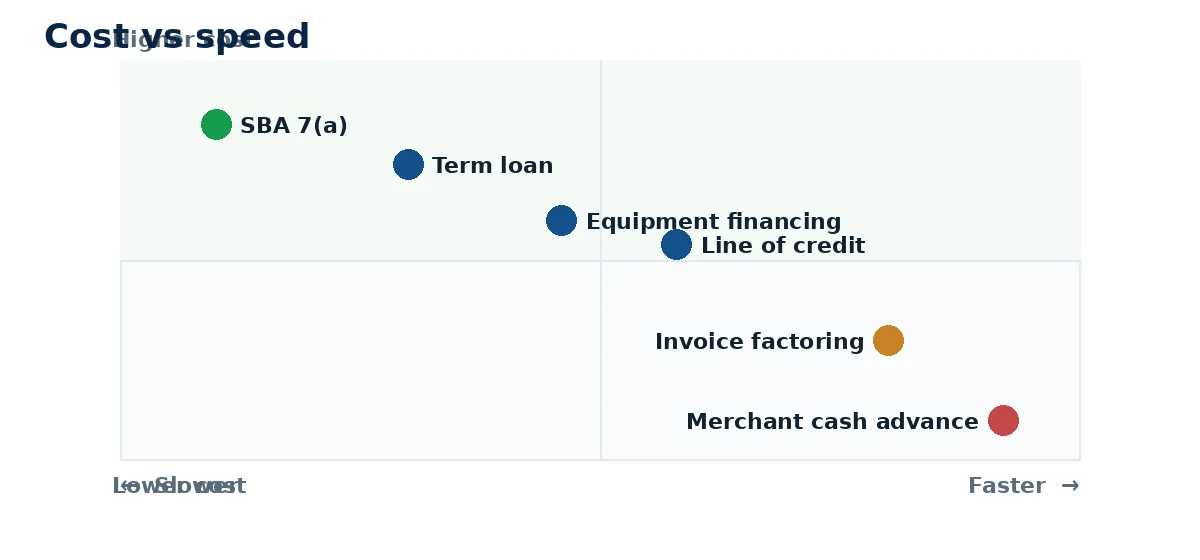
If your growth is gated by how much stock you can buy, inventory financing aligns capital with the assets you already manage. If your needs are broader, a line of credit is more versatile.
Comparison shopping is easier with actual offers. Check what you qualify for in minutes - it won’t affect your credit.