Invoice Factoring vs Business Line of Credit
Factoring turns your unpaid invoices into cash now. A line of credit gives you a reusable pool to draw from. Which fits depends on where your money is stuck.
See what you qualify for
months in business
monthly sales
credit score
- Factoring converts specific unpaid invoices into cash now and scales with your receivables; a line of credit is a reusable pool sized to your credit profile.
- Factoring is underwriting on your customers' credit, not yours - which helps newer or lower-credit B2B businesses.
- Factoring is asset-specific and often non-notification; a line is general-purpose and unencumbered.
- Many businesses use both: a line for operating expenses and factoring to accelerate slow-paying receivables.
Invoice Factoring vs Business Line of Credit at a glance
| Invoice Factoring | Business Line of Credit | |
|---|---|---|
| Collateral | Your receivables | General business credit |
| Who it suits | B2B with slow-paying customers | Any business with steady revenue |
| Amount scales with | Outstanding invoices | Your credit line limit |
| Repayment | From customer payments | On what you draw |
| Speed | Often 24-48 hours | 1-3 business days |
Choose Invoice Factoring if…
- B2B business waiting 30-90 days on invoices
- Staffing, trucking, wholesale, services
- You want funding tied to your sales, not debt on the balance sheet
Choose Business Line of Credit if…
- You need flexibility across many uses
- Your bottleneck is not receivables
- You want one facility you control
The fundamental difference: your customers vs your credit
Factoring asks a simple question: are your customers good for the money? If you invoice creditworthy businesses, a factor will advance cash against those invoices largely on the strength of your customers' credit, not your own. That makes factoring unusually accessible to young or credit-challenged B2B companies.
A line of credit asks a different question: is your business creditworthy and does it generate dependable cash flow? It is a general facility you can deploy for any purpose, but it is tied to your profile and capped by your limit.
How the money flows in each case
With factoring, you deliver, you invoice, and you submit the invoice. The factor advances a large share - commonly 80-90% - within a day or two, and releases the remainder minus its fee when your customer pays. The amount you can raise grows automatically as you take on more business.
With a line of credit, you draw up to your approved limit whenever you need to and repay on your own schedule. It does not scale with sales on its own - you have to ask for a limit increase - but it covers any expense, not just the ones tied to an invoice.
Cost and transparency
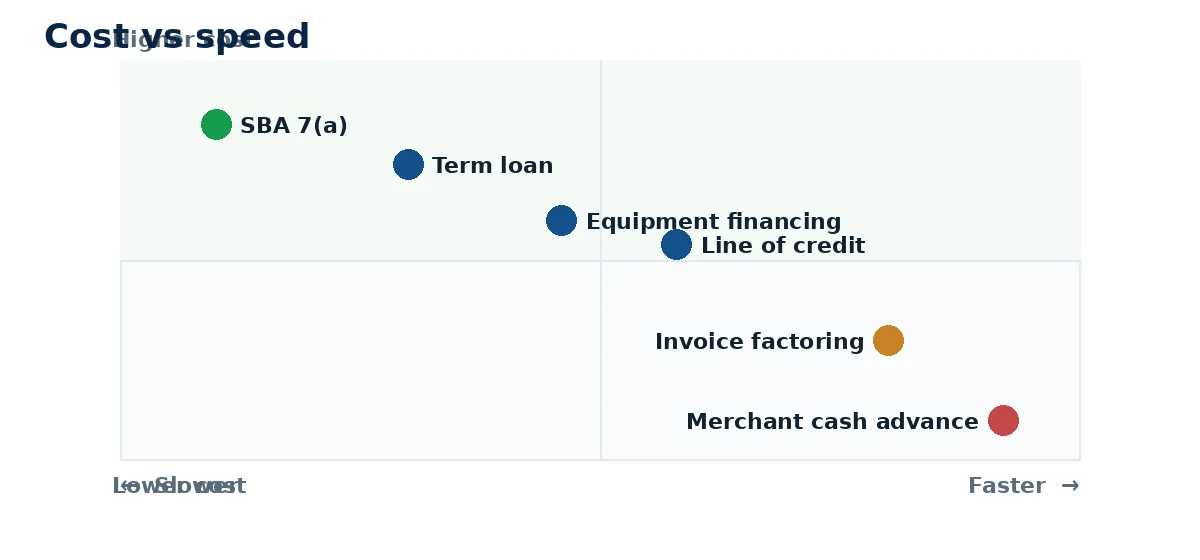
Factoring fees are typically a percentage per 30 days an invoice is outstanding, so faster-paying customers mean lower cost. Because the facility is tied to real receivables, pricing depends on your customers' credit and your invoice volume.
A line of credit costs interest on the drawn balance plus any fees. It is often cheaper per dollar for businesses that qualify well, but it does nothing for the specific problem of a customer sitting on an invoice for 75 days - factoring is built for exactly that.
The practical fit
Choose factoring when your bottleneck is the gap between delivering and getting paid, especially in staffing, trucking, wholesale, distribution, and B2B services. It turns your sales into cash on a predictable schedule and self-adjusts to your growth.
Choose a line of credit when your needs range beyond receivables - payroll smoothing, marketing, inventory, an opportunity - and you want one flexible facility you control. If you qualify, its flexibility and usually lower effective cost make it a strong anchor for day-to-day operations.
Can you use both?
Yes, and many growing B2B businesses do. Factoring accelerates the receivables that keep cash tight while a line of credit handles the operating swings factoring does not touch. The two together can smooth a business where revenue is solid but timing is brutal.
If you are not sure which your situation calls for, start with the question: is my money stuck in unpaid invoices, or do I need general, flexible capital? The honest answer points to the right product.
The verdict
If slow customer payments are your problem, factoring solves exactly that and scales with your sales. If your need is broader and recurring, a line of credit is more flexible.
Comparison shopping is easier with actual offers. Check what you qualify for in minutes - it won’t affect your credit.