Invoice Factoring vs Purchase Order Financing
Factoring is for money you are owed; PO financing is for orders you cannot yet afford to fill. Same cash-flow idea, opposite end of the cycle.
See what you qualify for
months in business
monthly sales
credit score
- Factoring comes after delivery and works on issued invoices; PO financing comes before delivery and works on confirmed orders.
- With factoring the cash typically goes to you; with PO financing it often goes to your suppliers.
- Both are anchored to your customers' credit, which makes them accessible to newer or lower-credit businesses.
- Sequenced together, they can fund a large order from supplier payment through to collection.
Invoice Factoring vs Purchase Order Financing at a glance
| Invoice Factoring | Purchase Order Financing | |
|---|---|---|
| Trigger | Issued invoices | Confirmed purchase orders |
| Money goes to | Your business | Usually your suppliers |
| Repaid when | Customer pays | The order completes and pays |
| Best for | Slow receivables | Large orders |
| Typical size | $100K+ facilities | $100K+ facilities |
Choose Invoice Factoring if…
- Customers pay slowly
- You have real receivables
- B2B services and goods
Choose Purchase Order Financing if…
- A big order you cannot fund up front
- You need to pay suppliers first
- Distributors and manufacturers
The trigger is the difference
Factoring is triggered by an invoice you have already issued. PO financing is triggered by a purchase order you have received but cannot yet afford to fulfil. One is about money owed to you; the other is about money you need to spend to earn money you are already owed.
That single distinction determines which one applies to your situation. If your problem is a customer sitting on an invoice for two months, that is factoring. If your problem is a huge order you would have to decline because you cannot fund the goods, that is PO financing.
Neither is better than the other - they are built for opposite halves of the cash-conversion cycle, and the right one is simply the one that matches where your cash is stuck.
What each one does with the money
In factoring, the funder advances a large share of an invoice to you, then collects from your customer and releases the balance minus a fee. The cash lands in your business to spend on whatever it needs - payroll, growth, expenses.
In PO financing, the money is usually directed to your suppliers, because the whole point is to get the goods produced and delivered. The financier is funding your cost of goods, not handing you working capital, and is repaid when the order completes and the customer pays.
So even the destination of the funds differs. Factoring funds your business; PO financing funds your order.
Fit, size, and eligibility
Both facilities commonly start around $100,000, and both underwrite your customers' creditworthiness more than your own - which is why they suit newer and lower-credit B2B businesses that banks decline. Factoring fits B2B services and goods with slow-paying but creditworthy customers: staffing, trucking, wholesale, distribution, professional services.
PO financing fits distributors, wholesalers, and manufacturers who can land orders larger than their working capital allows, and who pay suppliers up front. It needs a confirmed order; factoring needs a delivered, unpaid receivable - so both are anchored to real, verifiable transactions rather than projections.
If your customers are consumers, or your invoices are tiny and numerous, neither is usually the right tool.
Using them in sequence
For a large order that strains your cash, the two work as a relay. PO financing pays your suppliers so you can produce and deliver. Once delivered and invoiced, factoring accelerates the receivable so you are not waiting 60 days for the customer to pay.
The result is an order funded end to end without tying up your own working capital - which is exactly why wholesalers and distributors with big contracts often run both. Each tool handles its half of the cycle, and together they turn orders you would have to decline into orders you can take.
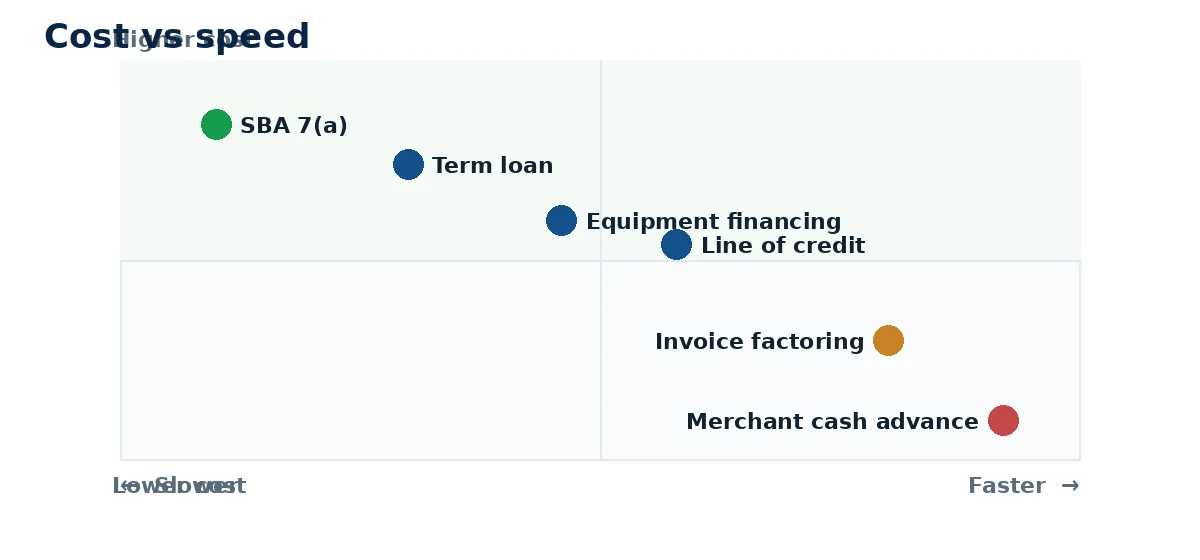
The verdict
Pick factoring to accelerate money you have already earned. Pick PO financing to take on an order that your cash flow could not otherwise support.
Comparison shopping is easier with actual offers. Check what you qualify for in minutes - it won’t affect your credit.