Business Line of Credit vs Term Loan
Both give you capital - but one is a reusable pool you draw from, and the other is a lump sum with fixed payments. Here is how to choose.
See what you qualify for
months in business
monthly sales
credit score
- A line of credit is a reusable pool - you draw, repay, and draw again; pay interest only on the outstanding balance.
- A term loan is a single lump sum repaid on a fixed schedule, usually at a lower rate because the amount is fully committed.
- If your need repeats (payroll gaps, slow invoices), a line usually costs less in total; if it is one defined project, a term loan is cleaner.
- Both are typically available in 1-3 business days, and checking your options is a soft inquiry that does not affect your credit.
Business Line of Credit vs Term Loan at a glance
| Business Line of Credit | Term Loan | |
|---|---|---|
| Best for | Ongoing, variable needs | One-time, defined investment |
| How you receive it | Revolving - borrow, repay, reuse | Single lump sum |
| Interest/fees on | Only what you draw | The full principal |
| Repayment | Flexible, on the balance used | Fixed schedule, set term |
| Typical timing | 1-3 business days | 1-3 business days |
| Cost | Pay only for what you use | Often lower rate on the full amount |
Choose Business Line of Credit if…
- Cash needs that repeat or fluctuate
- Wanting capital on standby
- Bridging gaps between invoices and payment
- Keeping one facility instead of repeated applications
Choose Term Loan if…
- A specific, one-time investment
- You want predictable fixed payments
- A large purchase or build-out
- Building business credit with a set payoff
How a business line of credit actually works
A line of credit is a pre-approved limit - say $75,000 - that you can draw against whenever you need it. You are not charged interest on the full limit, only on the portion you have actually used. As you repay, the available balance comes back, so the same facility can be reused for years.
That revolving structure is the whole point. A bakery that draws $20,000 to cover a flour order in March, repays it in May, and draws again in November for holiday packaging has funded three separate needs with one application and one credit relationship.
Most lines are annual or renewable and many lenders review them periodically. It is a working tool, not a windfall - the discipline is to draw for real needs and repay reliably, which keeps the facility healthy and re-priceable.
How a term loan actually works
A term loan hands you the full amount on day one and you repay it in equal installments over a set term, typically six months to ten years. Because the lender has committed the entire principal, rates are usually lower than on a line, and the payment schedule is fixed from the start.
Predictability is the advantage. A contractor financing a $150,000 build-out knows exactly what leaves the account each month for the next five years, which makes budgeting and forecasting straightforward.
The trade-off is flexibility: once you take a term loan, you are paying for the full amount whether or not you end up needing all of it. If you draw late or use only part of it, the cost of capital you did not need still lands on your balance sheet.
The real cost difference
The headline rate is only half the story. On a line of credit you pay interest on the drawn balance, so the effective cost depends on how much you use and for how long. On a term loan you pay for the full principal from day one, but often at a lower rate.
The practical test: how disciplined will you be? If you draw $75,000, hold it six months, and repay, a line and a term loan can come out close. If you only ever need $25,000 of a $75,000 facility at a time, the line wins on cost because you are never paying for the idle $50,000.
Watch the fees as well - origination, draw, maintenance, and early-payoff. A line with a low rate but a monthly maintenance fee can cost more than expected if you barely use it.
A worked example: $75,000 for a busy season
Suppose a B2B services firm needs about $60,000 spread unevenly across four months - heavy in month one, light afterwards - to front contractor payroll before client invoices land.
With a line of credit, it draws $40,000 up front, repays once invoices clear, draws $20,000 later, and pays interest only on what is outstanding at any moment. With a term loan, it borrows the full $75,000 and services payments on the entire amount even though its peak need was much smaller.
For that shape of need - seasonal and uneven - the line is the better fit. Flip the example to a fixed $75,000 equipment purchase with a known payback and the term loan's lower rate and fixed schedule become the smarter choice.
How lenders qualify each
Both generally want six months or more in business, roughly $10,000+ in monthly gross sales, and a credit score around 500+ to start, with better terms as your profile strengthens. Lines often look hard at cash flow and deposit consistency because they are reusable; term loans lean on the use of funds and repayment capacity for a defined amount.
Having clean, consistent business bank statements and a separate business account is the single biggest factor in how good an offer you see.
Common mistakes to avoid
The classic error is taking a term loan for a recurring need - paying fixed installments for money you keep topping up - or stretching a line of credit to fund a one-time asset that would have qualified for cheaper, longer-term financing.
Other traps: applying to several lenders in the same week (each hard pull can dent your score), ignoring early-payoff penalties, and treating a line as permanent working capital instead of a bridge you repay and reset. Used well, the two products complement each other - many businesses keep a line for fluid needs and use term debt for big, defined investments.
The verdict
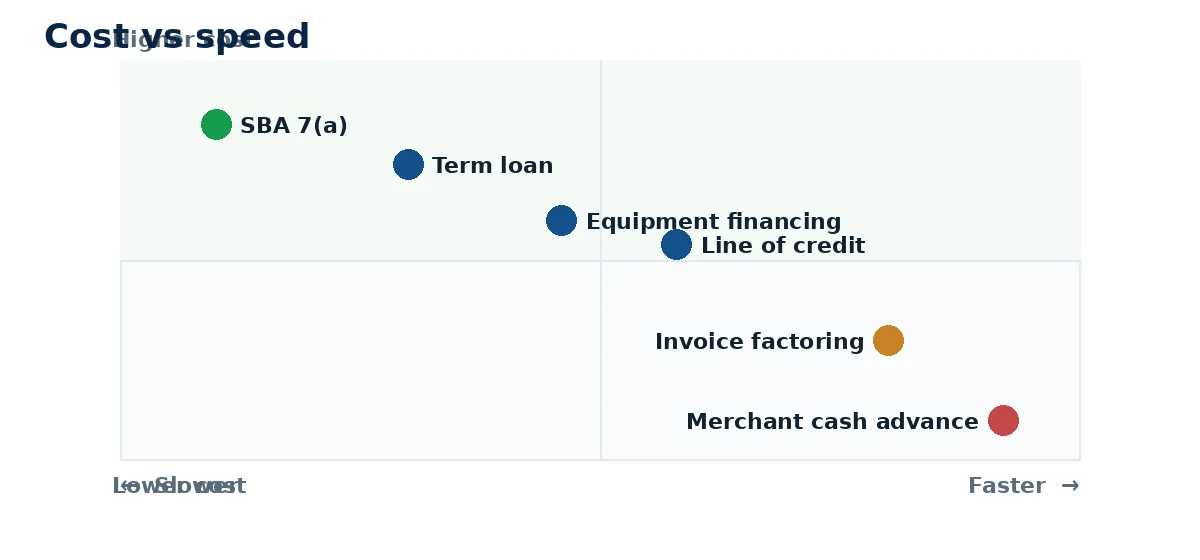
Choose a line of credit when your needs recur and you want to pay only for what you use. Choose a term loan when you have one defined goal and want a fixed payment that ends on a known date.
Comparison shopping is easier with actual offers. Check what you qualify for in minutes - it won’t affect your credit.