Merchant Cash Advance vs Business Line of Credit
An MCA is fast capital repaid from sales. A line of credit is lower-cost, reusable capital. Choose on cost versus speed and repayment style.
See what you qualify for
months in business
monthly sales
credit score
- An MCA is the faster, more expensive option; a line of credit is cheaper and reusable if you qualify.
- MCA repayment flexes with sales; a line of credit is repaid on your own schedule, usually with lower cost.
- Comparing a factor rate to an APR directly is misleading - annualize the MCA cost before you decide.
- Use an MCA for a genuine spike or emergency, and a line as the everyday, lower-cost workhorse.
Merchant Cash Advance vs Business Line of Credit at a glance
| Merchant Cash Advance | Business Line of Credit | |
|---|---|---|
| Cost | Higher | Lower |
| Speed | Often same/next day | 1-3 business days |
| Repayment | % of sales, flexes | On balance drawn |
| Requires | Steady card/daily sales | Steady revenue, 6+ months |
| Reuse | No | Yes |
Choose Merchant Cash Advance if…
- Urgent capital need
- Sales are steady but uneven week to week
- Thin documentation
Choose Business Line of Credit if…
- You want the lowest cost
- Recurring needs
- You qualify for standard underwriting
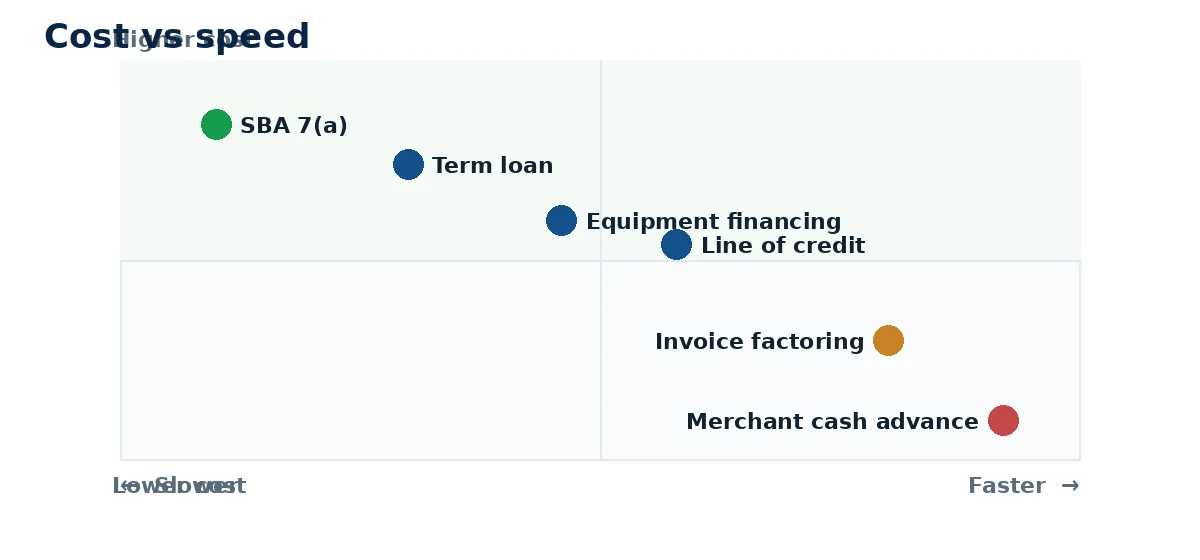
Cost versus speed is the whole decision
These two products sit at opposite ends of the trade-off that defines most business financing: how fast, and how much. An MCA is built for speed - decisions the same day, funds within a day or two, looser credit requirements. A line of credit is built for cost - better pricing, reusable, but dependent on standard underwriting.
If your need can wait a day or two and your profile supports it, the line is almost always the better economic choice. If waiting is not an option and you do not clear standard underwriting, an MCA may be the only realistic tool - and its premium is the price of that reality.
The trap is choosing an MCA because it feels easier, not because the need is genuinely urgent. That is paying a large premium purely to skip underwriting.
How repayment shape changes the picture
An MCA is repaid as a percentage of your sales, so payments rise and fall with revenue. For a business with genuinely uneven sales - restaurants, retail, seasonal services - that flexibility can prevent a soft month from turning into a missed payment. For steady revenue, the flexibility is worth far less.
A line of credit is repaid on your own schedule, with interest on the drawn balance. It gives you control and usually lower cost, but it expects you to manage repayment deliberately rather than having it skimmed automatically from daily sales.
If your cash flow is predictable, the line's control and cost win. If it swings hard, the MCA's automatic flexing has real value - just make sure it is worth the premium.
How to compare the cost fairly
You cannot compare an MCA's factor rate to a line's APR head-on because they are not the same kind of number. An MCA quote is typically a factor - for example, 1.35 on $40,000 means repaying $54,000. To compare honestly, work out total dollars repaid per dollar borrowed, then estimate how long the remittance will take at your sales level, and annualise roughly.
When you do that, the MCA's effective annualised cost is usually dramatically higher than any line of credit. Seeing that number plainly is the best defence against taking the easy option when the need was not actually urgent.
Do the same for the line: interest plus fees over the period you expect to hold the balance. Compare dollars out the door, not labels.
When each is the right call
Take the MCA for a genuine, time-boxed need - a supplier deadline, payroll on a Friday, a contract you cannot miss - or when your credit profile simply will not clear conventional underwriting today. Treat it as a bridge you perform on and graduate from.
Take the line of credit as the everyday workhorse: flexible, reusable, and materially cheaper per dollar. If you qualify, its only real weakness is that it will not fund you in an hour.
And if you are stacking an MCA on top of an existing one to cover the payment, stop - that is a signal the underlying cash flow needs fixing, not more speed.
The verdict
If you qualify and can wait a day or two, a line of credit is usually cheaper. Take an MCA only when speed genuinely outweighs cost.
Comparison shopping is easier with actual offers. Check what you qualify for in minutes - it won’t affect your credit.