Purchase Order Financing vs Invoice Factoring
PO financing funds the goods so you can fill an order you could not afford up front. Factoring unlocks capital from invoices you have already issued. One is before the sale, one is after.
See what you qualify for
months in business
monthly sales
credit score
- PO financing funds the front end of an order - paying suppliers so you can deliver; factoring funds the back end, unlocking cash from invoices already issued.
- Factoring usually advances cash to you; PO financing often pays your suppliers directly.
- Both lean on your customers' creditworthiness, which can make them accessible to newer or lower-credit businesses.
- Used together, they can carry a single large order from supplier payment to final collection.
Purchase Order Financing vs Invoice Factoring at a glance
| Purchase Order Financing | Invoice Factoring | |
|---|---|---|
| Timing | Before you deliver | After you invoice |
| Funds | Your suppliers / production | Cash against your receivables |
| Best for | Large confirmed orders | Slow-paying customers |
| Repaid from | Proceeds of the order | Customer payments |
| Fit | Distributors, wholesalers, manufacturers | B2B services and goods |
Choose Purchase Order Financing if…
- A large confirmed order exceeds your buying power
- You pay suppliers up front
- Distributors, wholesalers, manufacturers
Choose Invoice Factoring if…
- You have already invoiced and are waiting to be paid
- Slow-paying but creditworthy customers
- You want capital that scales with sales
Same cash-flow problem, opposite ends of the cycle
Both tools exist because B2B cash flow is a timing problem: money leaves before it arrives. Factoring attacks the back half - you have delivered and invoiced, but your customer will pay in 45 or 60 days. PO financing attacks the front half - you have a confirmed order you cannot afford to fulfil because suppliers want paying first.
That is the whole distinction in one line: factoring is for money you are owed; PO financing is for orders you cannot yet afford to fill.
Knowing which side of the cycle is squeezing you tells you which product you need before you look at a single rate.
How PO financing works in practice
You land a large, confirmed order from a creditworthy customer. Your problem is not demand - it is that fulfilling it requires buying goods or materials you cannot fund from working capital. A PO financier typically pays your suppliers directly and facilitates delivery, then is repaid from the proceeds when your customer pays.
Because the transaction is anchored to a real, confirmed order and a creditworthy buyer, underwriting focuses on those rather than solely on your balance sheet. That makes PO financing a route for distributors, wholesalers, and manufacturers to take on orders larger than their working capital would normally allow.
PO facilities commonly start around $100,000, and a confirmed order is generally a requirement - this is not capital for speculative inventory.
How factoring works in practice
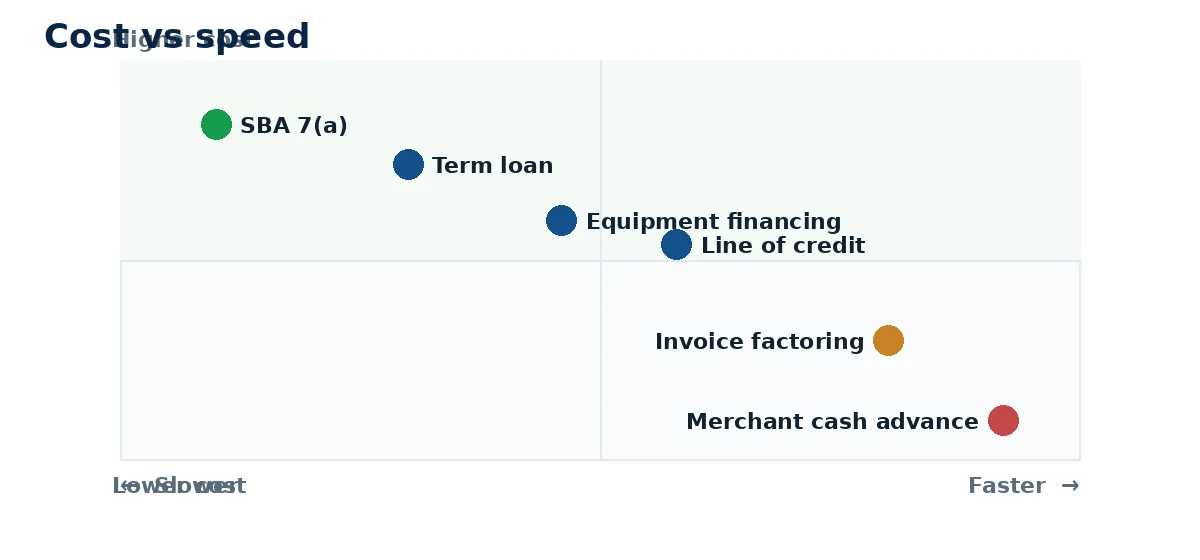
You deliver, invoice, and submit the invoice. The factor advances most of the value - often 80-90% - within a day or two, and releases the remainder minus a fee when your customer pays. The amount you can raise grows automatically as your sales grow, and underwriting leans on your customers' credit strength.
Factoring solves the specific pain of slow-paying but creditworthy customers, and it is one of the few facilities that scales with your revenue without a fresh application every time.
Where PO financing needs an order before delivery, factoring needs a delivered, uninvoiced-or-unpaid receivable. The trigger is entirely different.
Using them together
For a single large order, the two can work as a relay. PO financing pays your suppliers so you can produce and deliver. Once you have delivered and invoiced, factoring accelerates the receivable so you are not waiting on the customer to complete the cycle. The order is funded end to end.
That combination is common in wholesale and distribution, where a single big contract can otherwise be impossible to service with internal cash. Each tool does the part it was built for, and together they remove both bottlenecks at once.
The verdict
They solve opposite halves of the same problem. If the bottleneck is paying suppliers before a big sale, use PO financing. If it is waiting to be paid after the sale, use factoring. Many businesses use both.
Comparison shopping is easier with actual offers. Check what you qualify for in minutes - it won’t affect your credit.