SBA Loan vs Term Loan
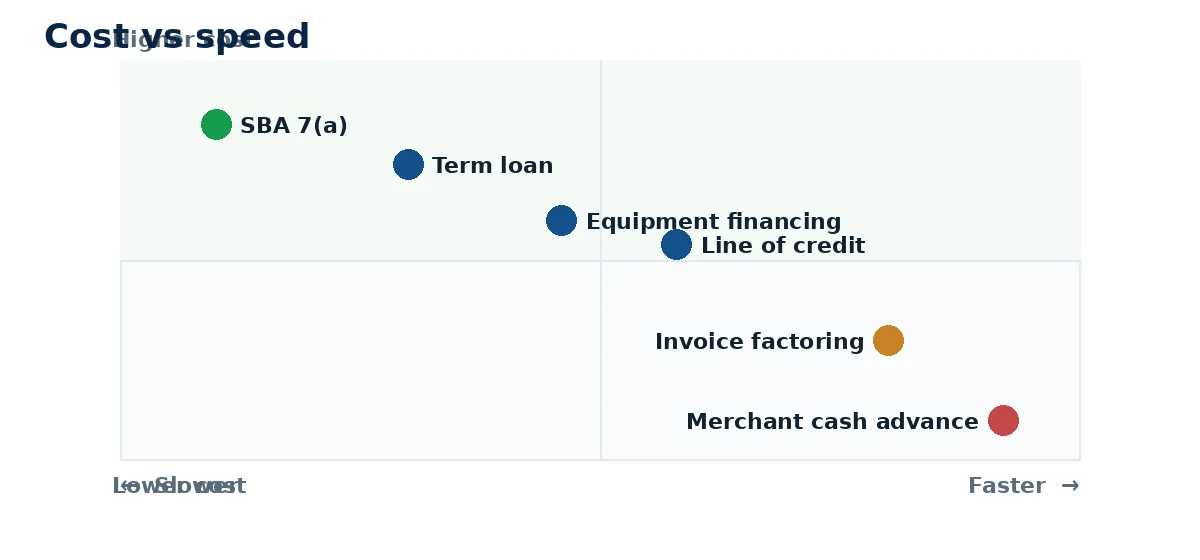
SBA loans offer the lowest rates and longest terms in exchange for more paperwork and time. A conventional term loan is faster and simpler.
See what you qualify for
months in business
monthly sales
credit score
- SBA loans win on cost and term length because the government guarantees part of the loan; conventional term loans win on speed and simplicity.
- Plan for 30-45 days (sometimes longer) for SBA versus 1-3 business days for a conventional term loan.
- SBA underwriting is stricter - expect tax returns, financials, and often collateral; conventional is lighter-document.
- For a large, long-life investment you can plan ahead for, the SBA's lower cost usually outweighs the wait.
Choose SBA Loan if…
- You can wait 30-45 days
- You want the lowest possible rate
- Large purchases: real estate, major equipment
- You have strong financials and documentation
Choose Term Loan if…
- You need funds in days
- A moderate amount for a defined purpose
- Less documentation
- Faster decisions
Why SBA loans cost less
The U.S. Small Business Administration does not lend money itself - it guarantees a portion of a loan made by a participating lender. That guarantee shifts risk off the lender's books, which lets the lender offer a lower rate and a longer repayment term than it otherwise would.
The effect over time is significant. On a large, multi-year loan, a couple of points of rate plus several extra years of term can mean tens of thousands of dollars in lower payments. That is the entire reason to accept the SBA's slower, heavier process.
What the SBA process really involves
Expect to provide two to three years of business and personal tax returns, year-to-date financial statements, a business debt schedule, and personal financial statements. Lenders also assess the use of funds and your ability to repay, and a personal guarantee is standard.
Because the file is larger and often needs SBA review, timelines run 30-45 days at best and can stretch to 60-90 for real estate. Plan for it and do not apply for SBA financing to solve a two-week problem.
Where a conventional term loan wins
A conventional term loan can be approved and funded in a day or two with a fraction of the paperwork. If the need is time-sensitive - an opportunity, a supplier deadline, payroll - the conventional route gets capital into your hands while the SBA file is still in review.
The price is a higher rate. On a modest, short-term need, that premium can be small in absolute dollars and well worth paying for speed. On a large, long-term need, the same premium becomes expensive - which is precisely when the SBA's slower, cheaper structure earns its keep.
A decision example
Imagine two businesses. The first needs $200,000 to buy a building it will occupy for 20 years. It can wait six weeks, and over two decades the SBA's lower rate and longer term save it a small fortune - clearly worth the paperwork.
The second needs $40,000 in ten days to stock inventory for a confirmed contract. Waiting 45 days is not an option, and at this size the interest difference over a short term is modest. A conventional term loan or line of credit is the right tool.
How to prepare for either
For the SBA: get your books clean, file your returns, and gather documentation before you apply so underwriting does not stall. For a conventional loan: have three to six months of business bank statements ready and apply early in the day.
And check your options first - a soft-inquiry pre-qualification shows you which route your profile actually supports before you spend weeks on an application that was never going to clear.
The verdict
Go SBA when time is not the constraint and cost is - you will save meaningfully over the life of the loan. Go conventional when speed and a light application matter more.
Comparison shopping is easier with actual offers. Check what you qualify for in minutes - it won’t affect your credit.