Working Capital Loan vs Merchant Cash Advance
Both put money in your account fast. Working capital gives you fixed payments; an MCA repays from a slice of sales. Choose by cost and cash-flow shape.
See what you qualify for
months in business
monthly sales
credit score
- Working capital gives you a fixed payment; an MCA repays a percentage of sales, so payments flex with revenue.
- Working capital is generally cheaper and more predictable - if you can qualify and handle fixed payments.
- An MCA funds faster with looser credit requirements but costs materially more.
- Choose by cost and cash-flow shape, not by which one approves more easily.
Working Capital Loan vs Merchant Cash Advance at a glance
| Working Capital Loan | Merchant Cash Advance | |
|---|---|---|
| Repayment | Fixed schedule | % of sales |
| Cost | Generally lower | Higher |
| Predictability | High | Payment flexes with sales |
| Underwriting | Standard | Looser |
| Best for | Known, one-time needs | Urgent needs, uneven sales |
Choose Working Capital Loan if…
- You can handle fixed payments
- A defined gap or opportunity
- You qualify for standard pricing
Choose Merchant Cash Advance if…
- Speed is critical
- Sales swing week to week
- Thin documentation
Fixed payment versus flexible remittance
This is the difference that matters most. A working capital loan sets a fixed payment on a fixed schedule: the same amount leaves your account every period whether the month was strong or weak. An MCA remits an agreed percentage of your sales, so a slow week lowers the payment and a strong week pays the balance down faster.
For predictable revenue, a fixed payment is easier to plan around and often cheaper. For genuinely uneven revenue, the MCA's automatic flexing can be the difference between comfortably absorbing a soft month and missing a payment - though you pay for that flexibility.
Neither shape is wrong. The question is which matches how money actually arrives in your business.
Cost and predictability
Working capital financing is generally less expensive and fully predictable. You know the rate, the payment, and the end date, which makes it easy to model against your margins. It is the cleaner choice whenever you qualify and can handle the fixed obligation.
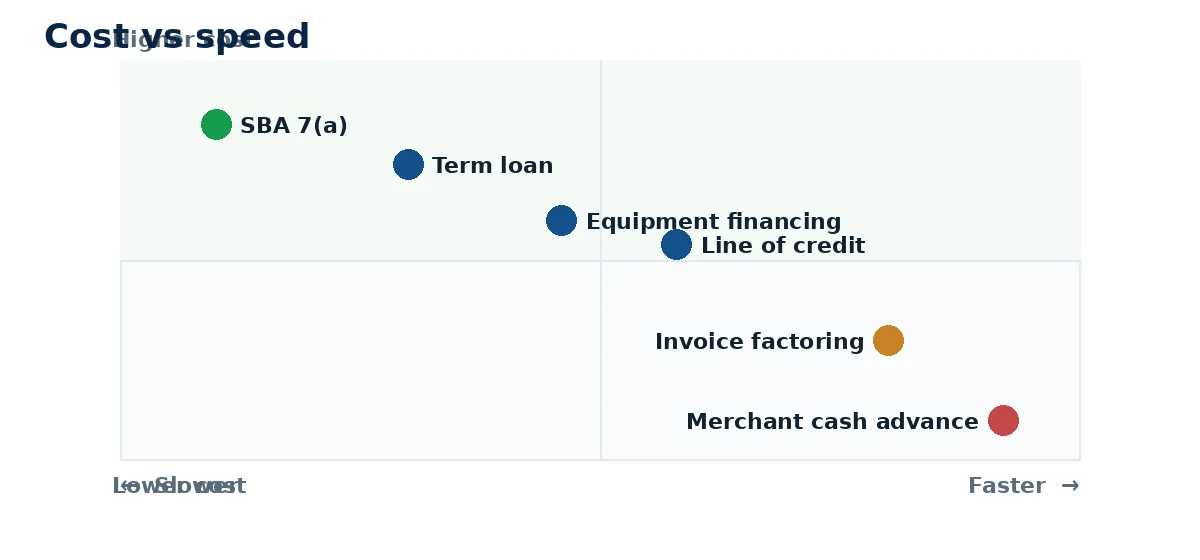
An MCA is the opposite trade: faster, looser requirements, and materially more expensive. Its remittance is not fixed, so the total cost varies with how quickly your sales retire the balance - strong sales can mean paying it down fast and paying less in total; slow sales can mean the opposite.
The trap is picking an MCA purely because the monthly 'feels' smaller. With a percentage-of-sales remittance, the obligation is real and it scales with your revenue - it just does not look like a fixed bill.
Qualification and speed
Underwriting differs sharply. Working capital financing goes through a standard review - revenue, time in business, credit - and usually funds in one to three business days. An MCA leans on your card or daily sales with looser credit requirements and can fund in as little as a day or two, sometimes same-day.
So if you clear standard underwriting, the working capital route gets you a cheaper, cleaner product without much speed penalty. If your profile will not clear, the MCA's looser bar may be the only realistic option - and its cost is the price of access.
Be honest about which situation you are in. Choosing the looser product when you would have qualified for the cheaper one is simply paying more than necessary.
A practical decision
Ask whether your revenue is predictable enough to carry a fixed payment, and whether you expect to qualify for standard underwriting. Yes to both points to working capital. No to either - if the need cannot wait, or your sales swing hard, or your profile will not clear - points to an MCA as a bridge.
If you do take the MCA, plan the graduation: perform on it, build clean statements, and move to a working capital loan or line of credit as soon as you can. Speed-premium capital should be a season in your business, not a permanent fixture.
The verdict
If your revenue is predictable and you qualify, working capital is the cheaper, cleaner choice. If you need capital now and want repayment to move with sales, an MCA can fit.
Comparison shopping is easier with actual offers. Check what you qualify for in minutes - it won’t affect your credit.