How Invoice Factoring Works
By Tim Carre, Senior Vice President · Reviewed by the TopBizCapital editorial team
Invoice factoring turns unpaid invoices into cash now. Walk through how it works, what it costs, and whether it fits your B2B business.
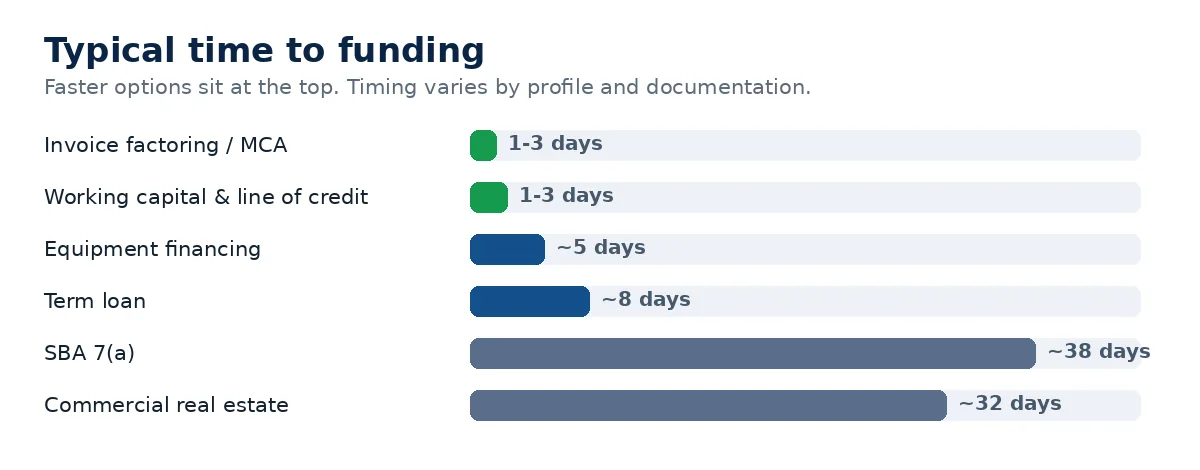
- Factoring sells your invoices at a small discount so you get most of the cash immediately instead of waiting 30-90 days.
- It is not a loan - it is the purchase of a receivable, so it does not add traditional debt to your balance sheet.
- Underwriting focuses on your customers' credit, which makes factoring accessible to newer or lower-credit B2B businesses.
- Fees are typically a percentage per 30 days an invoice is outstanding, so faster-paying customers cost less.
- Ask about notification, recourse, minimums, and whether they fund single invoices or a full ledger.
The basic idea
You deliver a product or service, issue an invoice, and then wait 30, 60, or 90 days to be paid. For a growing B2B business, that wait is often the only thing standing between it and its next hire. Factoring fixes the wait: you sell the invoice to a funder at a small discount and receive most of the cash almost immediately.
The important distinction is that factoring is not a loan. It is the sale of a receivable. That matters for your balance sheet - rather than adding debt, you have converted an asset (the invoice) into cash - and it matters for who the lender is really underwriting: your customer, not you.
This is why factoring is one of the few financing tools genuinely available to a young or credit-challenged B2B business: the factor cares that your customer is good for the money.
The step-by-step
You deliver the work and issue the invoice. You submit the eligible invoice to the factor, along with proof of delivery. The factor advances a large share - often 80-90% - within a day or two. When your customer pays, the factor releases the remaining balance minus its fee.
From your side it is simple and repeatable: deliver, invoice, submit, get funded. Once a facility is set up, the cycle runs continuously, and the amount you can raise grows automatically as you take on more business. That self-scaling is factoring's quiet superpower.
What it costs
Fees are typically a small percentage per 30 days an invoice remains outstanding. If your customer pays in 30 days, you pay one increment; if they take 75 days, you pay more. That aligns the factor's incentive with getting your customers to pay on time.
When you compare factors, compare the all-in fee against how much earlier you get the cash. If $50,000 arrives 45 days sooner and lets you take on another contract, a modest factoring fee is cheap compared with the lost revenue of waiting.
Notice vs non-notification, recourse vs non-recourse
Notification means your customers are told to pay the factor directly; non-notification means you keep collecting and simply remit to the factor, so your customers never know. Non-notification is common and protects your customer relationships, though it can carry a slightly higher fee.
Recourse means you buy back an invoice if the customer does not pay within a set period - you carry the non-payment risk. Non-recourse means the factor absorbs that risk, in exchange for a higher fee and stricter customer-credit screening. Which you want depends on how strong your customers' credit is and how much protection you need.
Who it fits
Factoring suits B2B businesses with creditworthy customers and real invoices: staffing, trucking, wholesale, distribution, manufacturing, and professional services. The pattern is always the same - solid sales, slow payment, and growth limited only by how long the cash takes to arrive.
It fits less well if your customers are consumers, if your invoices are small and numerous, or if your margins are so thin that even a small factoring fee hurts. In those cases a line of credit or a term loan is usually a better tool.
A worked example
A staffing agency invoices $300,000 a month with 45-day terms. It cannot make payroll at that pace. It factors the invoices: the factor advances 88% ($264,000) within two days, and releases the remaining 12% minus a fee when the clients pay. Payroll is covered, and the agency can take on more placements without waiting on cash.
The agency has not borrowed anything - it has sold receivables it already owned. Its balance sheet stays clean, and its only real cost is the factoring fee, which it now treats as the price of operating at scale.
How to choose a factor
Ask about notice versus non-notification, recourse versus non-recourse, the fee structure and whether it is per invoice or tiered by volume, minimum monthly volume requirements, and whether they fund single invoices or require your whole ledger. Also ask about setup time and how quickly they advance once you are live.
Get the total cost in writing for a realistic month of your volume. A factor with a friendly rate but a high minimum you cannot hit can cost more than one with a slightly higher rate and no minimum.
Factoring vs a loan or line of credit
A loan or line of credit is debt and depends on your credit and cash flow; factoring is the sale of an asset and depends on your customers. If slow payment is your specific problem, factoring solves exactly that and scales with your sales. If your needs range more broadly, a line of credit gives you more flexibility - and many businesses use both.
If you are unsure which fits, start with the question: is my money stuck in unpaid invoices, or do I need general, flexible capital? The honest answer points to the right product.