Merchant Cash Advance vs Term Loan
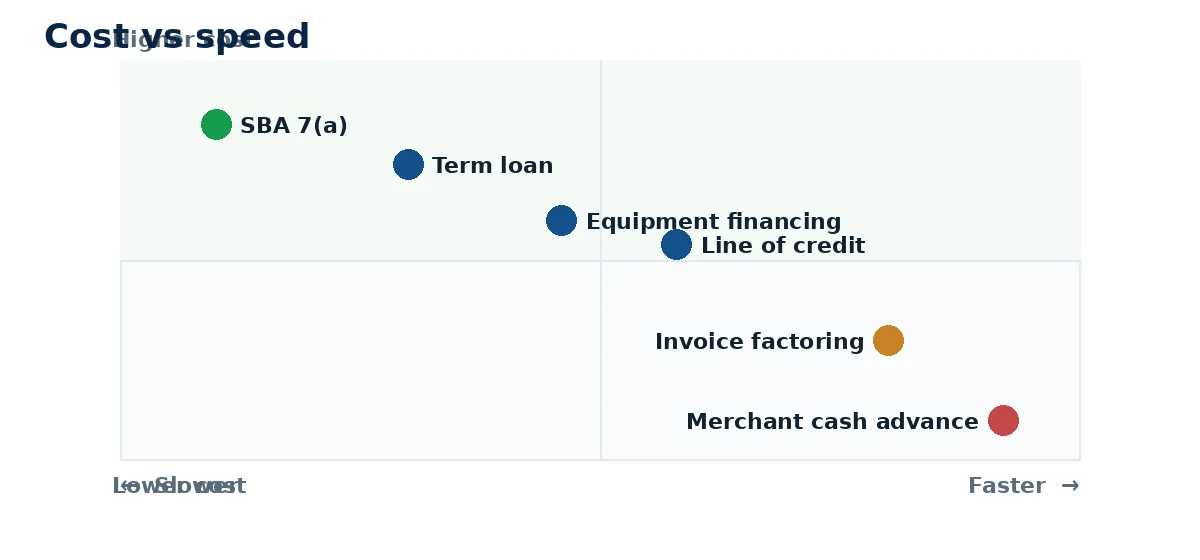
An MCA trades higher cost for speed and repayment that flexes with sales. A term loan costs less but comes with fixed payments. Pick by what your cash flow can handle.
See what you qualify for
months in business
monthly sales
credit score
- An MCA is repaid as a percentage of future sales, so payments move up and down with revenue; a term loan has a fixed payment.
- Compare cost properly: MCAs quote a factor rate, which annualizes much higher than a term loan's rate.
- Take an MCA for genuine urgency, not routine operating cash - the cost of speed compounds if you roll it.
- If you can wait a day or two and qualify, a term loan is almost always the cheaper capital.
Merchant Cash Advance vs Term Loan at a glance
| Merchant Cash Advance | Term Loan | |
|---|---|---|
| Repayment | % of future sales | Fixed periodic payment |
| Speed | Often same/next day | 1-3 business days |
| Cost | Higher - you pay for speed | Lower rate, more paperwork |
| Credit impact | Generally minimal | Generally minimal |
| Best when | Sales are steady and you need capital now | You can commit to fixed payments |
Choose Merchant Cash Advance if…
- You need capital fast and sales are consistent
- Revenue dips some weeks - flexible repayment helps
- Card/daily-sales business
Choose Term Loan if…
- You qualify for lower-cost financing
- You want a fixed payoff date
- You prefer predictable payments
How repayment actually differs
This is the decisive difference. A term loan charges a fixed amount on a set day, so a slow month still means the full payment - and a healthy month means nothing extra. An MCA remits an agreed percentage of your card or daily sales, so a slow week automatically lowers the payment and a strong week pays it down faster.
For a business with genuinely uneven revenue - restaurants, retail, seasonal services - that flexibility can be the difference between comfortably absorbing a soft month and missing a payment. For a business with steady revenue, the flexibility is worth less, and you are paying a premium for a feature you do not need.
Decoding the cost: factor rate vs APR
MCAs do not quote interest - they quote a factor rate. A 1.35 factor on a $40,000 advance means you repay $54,000 over the term. That looks like a modest 35% until you annualize it against the short repayment window, at which point the effective APR is dramatically higher than any term loan.
When you compare, do the arithmetic: total repaid divided by amount advanced tells you the all-in multiplier, and you should estimate how many months the remittance will take based on your sales. A term loan's rate, finance charges, and fees should be added up the same way so you are comparing dollars out the door, not marketing labels.
When an MCA is the right call
An MCA earns its cost in a narrow set of situations: a time-sensitive opportunity or obligation you cannot miss, a credit profile that will not clear conventional underwriting today, or a revenue pattern where fixed payments would genuinely strain you.
It is a bridge, not a foundation. The healthy pattern is to use one MCA for a defined need, build payment history and revenue, then graduate to a line of credit or term loan that costs materially less per dollar borrowed.
When a term loan is the right call
If you can wait even a day or two and your profile supports it, a term loan gives you the same money at a fraction of the cost, with a payment you can plan around. For a planned investment - equipment, a build-out, inventory for a known season - a term loan's lower cost compounds into real savings over its life.
The catch is discipline: you must be able to honor a fixed payment in a soft month. If your cash flow truly cannot absorb that, the MCA's flexible remittance may be worth the premium, at least temporarily.
A practical rule of thumb
Ask two questions: How urgent is this, honestly? And can my cash flow carry a fixed payment? Urgent plus uneven sales points to an MCA. Planned plus predictable sales points to a term loan.
If you are tempted by an MCA only because it feels easier to approve, slow down - paying a large premium purely to skip underwriting is rarely a good trade. And never borrow to cover a shortfall you expect to repeat every month; that is a profitability problem, not a financing one.
The verdict
If speed matters most and your sales are steady, an MCA can work. If you can wait a day or two and want the lowest cost, a term loan is usually the better deal.
Comparison shopping is easier with actual offers. Check what you qualify for in minutes - it won’t affect your credit.